Backflow incense burners
How does backflow incense work? The physics, plainly
Backflow incense flows down because smoke drawn through a hollow cone comes out cooler and full of particles, so it's denser than air. Here's how it works.
Backflow incense works because smoke drawn down through a hollow cone comes out of the base cooler and loaded with particles. That makes it denser than the air around it, so it sinks instead of rising. The burner gives that heavy smoke a path to follow, which is where the waterfall or mist effect comes from.
That's the short version. Here's what's going on in a bit more detail.
Normal incense: why smoke rises
When a normal incense cone or stick smoulders, it heats the air and gases right around the burning tip. Hot air is less dense than the cooler air around it, so it rises. It carries the smoke with it. That's why ordinary incense sends up a thin column that curls and spreads as it goes.
Backflow cones: a different shape
A backflow cone looks like a normal cone from the side. Turn it over and you'll see a hole in the base. That hole leads to a hollow channel running up inside the cone.
As the cone burns down from the tip and reaches the top of that channel, some of the smoke has two ways out:
- up, off the tip, like normal incense
- down, through the hollow channel, and out of the hole in the base
When the cone sits on a backflow burner, the hole in the base lines up with a hole in the burner. That gives the smoke an open path downwards into the burner's internal channels.
Why the smoke sinks
Two things change as the smoke travels down the channel.
It cools. Smoke that goes straight up off the tip stays hot for a while. Smoke that travels down through the cone and into the burner has time to lose heat before it comes out. Cooler air and smoke is denser than warm air.
It's carrying a lot of particles. Smoke is made of tiny particles and droplets suspended in air. The smoke that comes out of the base is thick with them. All that extra material makes the smoke heavier than the clean air around it.
Put those together and you get smoke that's denser than the surrounding air. Like water poured from a jug, it falls and spreads out across whatever is below it. On a burner shaped like a waterfall, a dragon or a hand holding a flower, it pours over the edges and pools at the bottom.
Why it's so easily disturbed
The difference in density between the smoke and the room air is small. That's why backflow is so sensitive to its surroundings. A few things tip the balance the wrong way:
- Draughts push the smoke sideways or lift it before it has a chance to fall.
- Warm rooms or nearby heaters mean the smoke doesn't cool as much, and rising warm air from a radiator carries it upwards.
- Damp cones burn unevenly and produce thinner smoke that doesn't hold together.
- Standard solid cones have no channel, so there's no path for the smoke to go down. It all rises.
- Blocked or misaligned holes stop the smoke getting into the burner, so it escapes upwards instead.
- Lighting it badly matters too. If the cone keeps a flame, it burns too hot. If it goes out, there's no smoke at all.
If you're having trouble, our backflow troubleshooting checklist goes through each of these in turn.
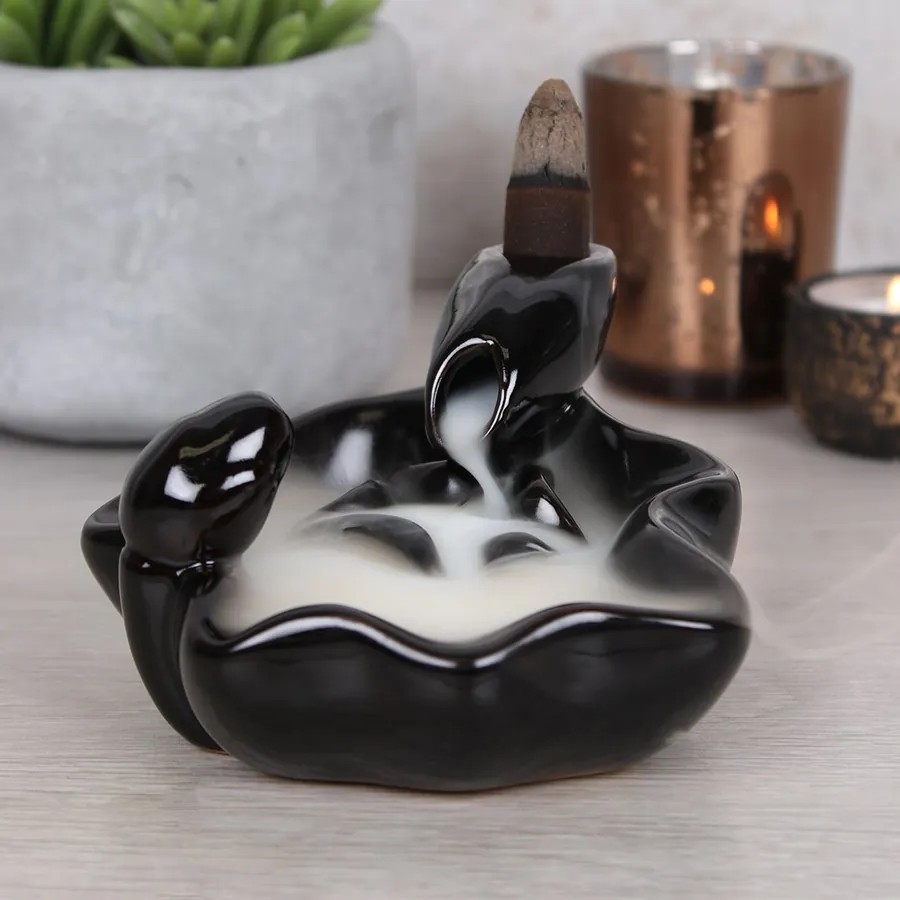
Pool to Pool Backflow Incense Burner
A simple, low black burner. Smoke pours into a small pool, then spills over into a larger one.
£7.99
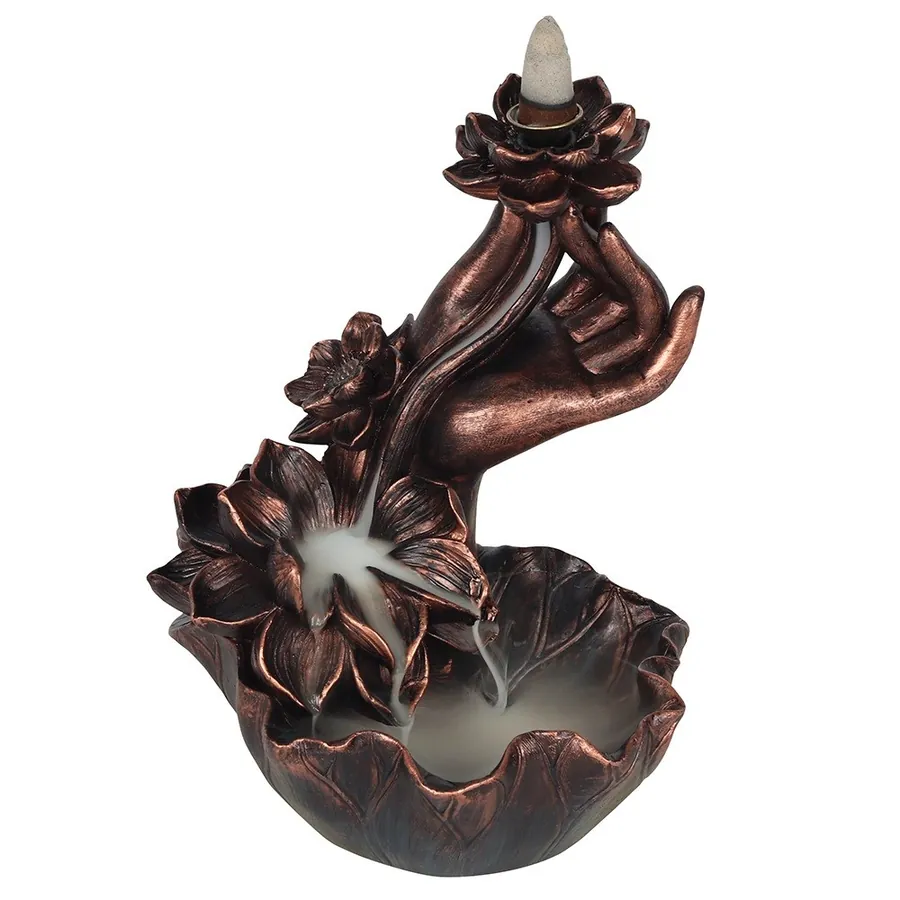
Bronze Effect Hand and Lotus Backflow Incense Burner
A bronze effect hand holds a lotus flower. Smoke from a backflow cone spills over the petals and pools in the bowl below.
£29.99
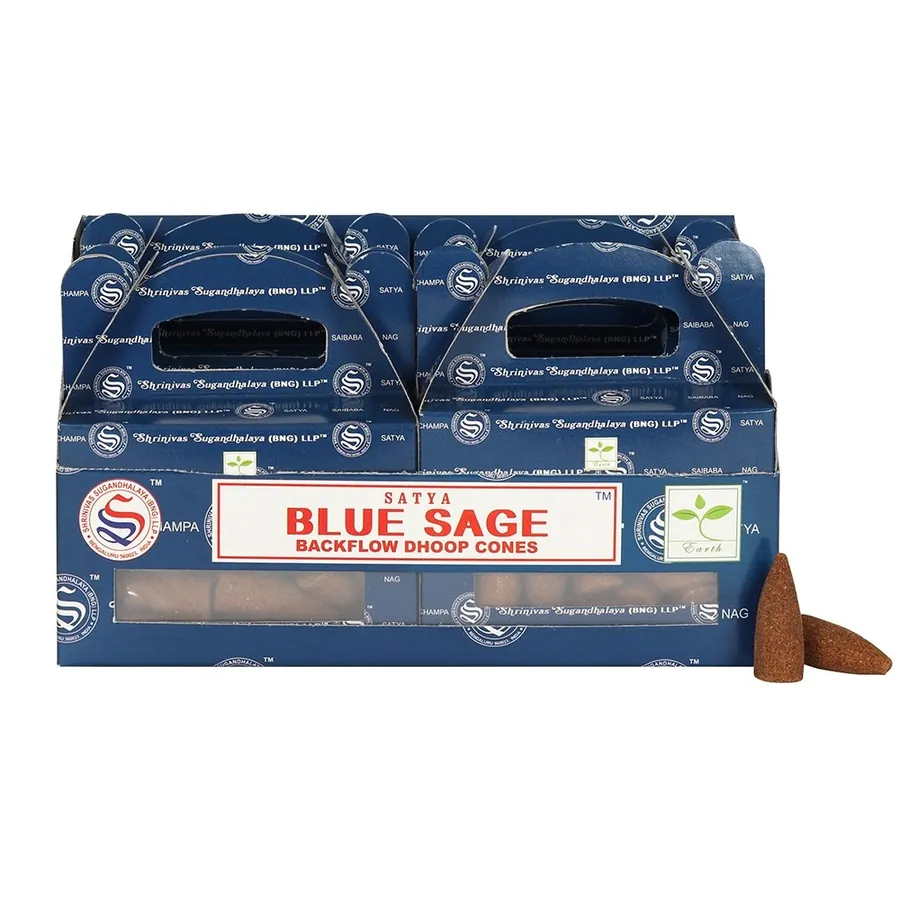
Satya Blue Sage Backflow Cones, 6 Packs
A display box of 6 packs of Satya Blue Sage backflow dhoop cones, made in India, for backflow incense burners.
£22.99
What the burner does
The burner isn't just decoration. It does three practical jobs:
- It holds the cone in the right place, with the hole lined up over an opening.
- It gives the smoke a channel to travel down, which adds cooling time.
- It shapes the flow. The outlet, the slopes and the pools decide where the smoke goes and how it looks. A tall design gives a long fall. A pool design lets the smoke collect and overflow from one level to the next.
Burners are usually made of resin or ceramic, both of which handle the heat of a small smouldering cone. Over time, residue from the smoke builds up inside, which is why burners need cleaning now and then. See how to clean a backflow incense burner.
Why some smoke still goes up
Even when everything is right, you'll see some smoke rising from the tip. The tip is still a hot, burning point, so the smoke right there behaves like normal incense. Backflow is about most of the smoke being routed downwards, not all of it.
You'll also notice it doesn't start straight away. Smoke usually begins flowing down once the burn reaches the hollow channel. That's often a minute or two after lighting.
Does the scent work differently?
Not really. Backflow cones are still incense, so they give off scent as they burn, the same way any cone does. The difference is visual. The flowing smoke is the reason most people buy a backflow burner.
How long does it last?
A backflow cone typically burns for around 10–15 minutes, depending on size and brand. Jumbo cones are bigger and last longer. Check the packet for the maker's own guidance.
Smoke is still smoke
The fact that backflow smoke sinks doesn't make it any different from other incense smoke. It still contains fine particles and it will spread through the room over time. Burn it in a ventilated room, keep it away from pets and children, and never leave it unattended. Our guide to whether backflow incense is safe covers this properly.
Putting it into practice
Knowing the physics makes it easier to get a good result:
- Choose a still corner, away from heaters.
- Use dry, genuine backflow cones.
- Line the cone's hole up with the burner's hole.
- Light it, let it flame briefly, then blow it out.
- Give it a minute or two and don't disturb the air around it.
Our step-by-step guide on how to use a backflow incense burner has the full routine. When you're ready, browse our backflow incense burners and backflow cones, all shipped from UK stock. See delivery for timings.
Questions people ask
How does backflow incense work?
A backflow cone has a hollow channel through the middle. As it smoulders, smoke is drawn down that channel and comes out of the base. By then it has cooled and is carrying lots of particles, so it is denser than the air around it and sinks, flowing down through the burner.
Do backflow incense burners work?
Yes, when they're used with proper backflow cones in still air. The effect is real but delicate. Draughts, warm rooms, damp cones and blocked holes can all stop the smoke flowing down.
What makes backflow incense work?
Two things together: the hollow cone, which sends smoke down a channel instead of letting it rise straight off the tip, and the burner, which gives the smoke a path to fall along. The smoke sinks because it leaves the cone cooler and heavier with particles than the room air.
How do backflow incense holders work?
The holder has a hole at the top that lines up with the hole in the base of the cone. Smoke passes through that hole into channels inside the holder, then comes out lower down and runs over the surfaces, steps or pools of the design.